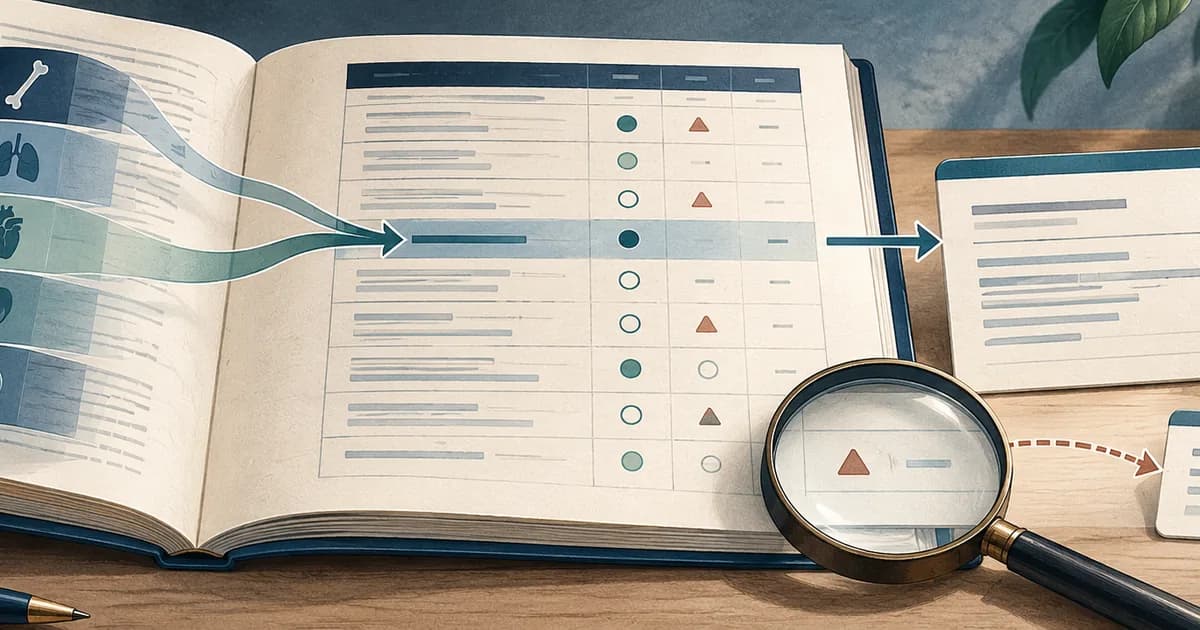
The FY2027 “with” or “in” presumption applies when the classification itself links two documented conditions. Check for an unrelated-condition statement or a rule requiring explicit linkage, then verify the complete Tabular entry.
The short answer: look for the link in the classification
FY2027 ICD-10-CM can presume a causal relationship when “with” or “in” links two conditions in the classification itself. Under Official Guidelines I.A.15, the linking term may appear in a code title, under an Alphabetic Index main term or subterm, or in a Tabular List instructional note. In that defined setting, the conditions are treated as related without an additional provider sentence explicitly stating the link, unless the documentation clearly says they are unrelated or another guideline specifically requires documented linkage. If the classification does not link them through these terms, or a guideline requires an explicit link, the provider documentation must establish the relationship.
This article addresses the U.S. FY2027 ICD-10-CM diagnosis classification. CDC/NCHS lists its October 1, 2026 release for services through September 30, 2027, subject to later official updates. This convention is a rule for reading the classification; it neither documents a condition absent from the record nor settles a particular patient’s code assignment.
Source: CMS/NCHS: FY2027 Official Guidelines, I.A.15, I.A.19 and I.B.1
Where to look for “with” and “in”
The location matters more than a casual use of either word in ordinary prose. In the versioned FY2027 Alphabetic Index, inspect the main term and its indented subterms. I.A.15 says a “with” subentry appears immediately after the main term or subterm, rather than in alphabetic order. Skipping that early line because you expect alphabetical placement can hide a relevant official path.
The same convention may be printed in a code title or a Tabular List instructional note. Read the exact title or note in the released FY2027 Index and Tabular package, including the heading and inherited instructions. The mere fact that a clinical sentence contains the word “with” does not show that the classification has made this particular link.
Source: CMS/NCHS: FY2027 Official Guidelines, I.A.15, I.A.19 and I.B.1
Two boundaries that stop an automatic presumption
- The record clearly says the conditions are unrelated. I.A.15 expressly makes this an exception to the classification’s presumption. Do not override a clear contrary statement by reading only the Index heading.
- A more specific guideline requires a documented link. Follow that requirement even if a broad phrase looks suggestive. When no “with” or “in” link exists in the classification at all, provider documentation must link the conditions before treating them as related.
If the relationship is unclear or documentation conflicts, the safe next step is qualified review and, where appropriate, clarification from the provider. The FY2027 guidelines also state in I.A.19 that code assignment rests on the provider’s diagnostic statement; a layout convention does not create a diagnosis. The combination-code lookup guide addresses the separate question of whether one code captures documented elements after the relationship question has been resolved.
Source: CMS/NCHS: FY2027 Official Guidelines, I.A.15, I.A.19 and I.B.1
A five-step check for a reference lookup
- Set the release. Match the relevant date to the official CDC/NCHS period.
- Confirm both documented conditions. Do not infer an undocumented diagnosis from a source entry.
- Find the official link. Check the main term, the immediately following “with” subentry, the code title, and any Tabular instructional note in the FY2027 source files.
- Check exceptions. Look for a clear unrelated-condition statement and any applicable guideline demanding explicit provider linkage.
- Verify the full candidate entry. I.B.1 requires the Index path to be checked against the Tabular List, including instructional notations, completeness, and any required characters. Escalate a patient-specific decision to a qualified reviewer.
Diagram-ready takeaway: documented terms → official “with”/“in” link → exception check → full Tabular entry → reviewed decision. This is a source-reading path, not a shortcut around documentation. The available Android, iPhone and Mac apps can help reopen a versioned reference during that check; the official FY2027 files remain the authority.
Source: CMS/NCHS: FY2027 Official Guidelines, I.A.15, I.A.19 and I.B.1
Keep this rule separate from other Index shortcuts
The “with” convention is about a presumed relationship between conditions expressly linked in the classification. A main-term default answers a different question: which code is shown when a condition is documented without added detail. A “see” or “see also” direction sends the lookup to another term. None of these rules replaces the complete-entry check in our Index-to-Tabular guide.
For a reproducible review note, keep the FY2027 release, the exact Index line or code title, any relevant Tabular instruction, and the documentation fact that supports or blocks the presumed relationship. If a piece is missing, leave the assignment open for review rather than guessing from a search result or isolated code title.
Common questions
Does any mention of two conditions together create a “with” relationship?
No. The presumption in FY2027 I.A.15 depends on “with” or “in” linking those conditions in the classification’s Index, title, or Tabular instructional note. Otherwise, provider documentation must establish the link.
Where is a “with” subentry in the Alphabetic Index?
I.A.15 places it immediately after the main term or subterm, rather than in ordinary alphabetic order. Read that line in the full released Index.
What if the provider says the two conditions are unrelated?
A clear unrelated-condition statement is an express exception to the I.A.15 presumption. The record and applicable specific guidelines need qualified review.
Can I stop after finding the “with” entry?
No. FY2027 I.B.1 requires verification of the candidate in the Tabular List and attention to instructions in both components. The source path alone does not finalize a patient-specific code.
Sources & editorial notes
- CMS/NCHS: FY2027 Official Guidelines, I.A.15, I.A.19 and I.B.1
- CDC/NCHS: FY2027 release dates and files
- CDC/NCHS: released FY2027 Index and Tabular package
- Versioned FY2027 source library
Scope: U.S. FY2027 ICD-10-CM diagnosis classification, October 1, 2026–September 30, 2027, subject to later official updates; general reference-navigation education. Educational reference content, prepared with AI assistance; not independently reviewed by a credentialed clinical coding specialist. Verify official instructions and the applicable documentation before assigning codes. Our editorial approach.
Found an error? Send a correction.