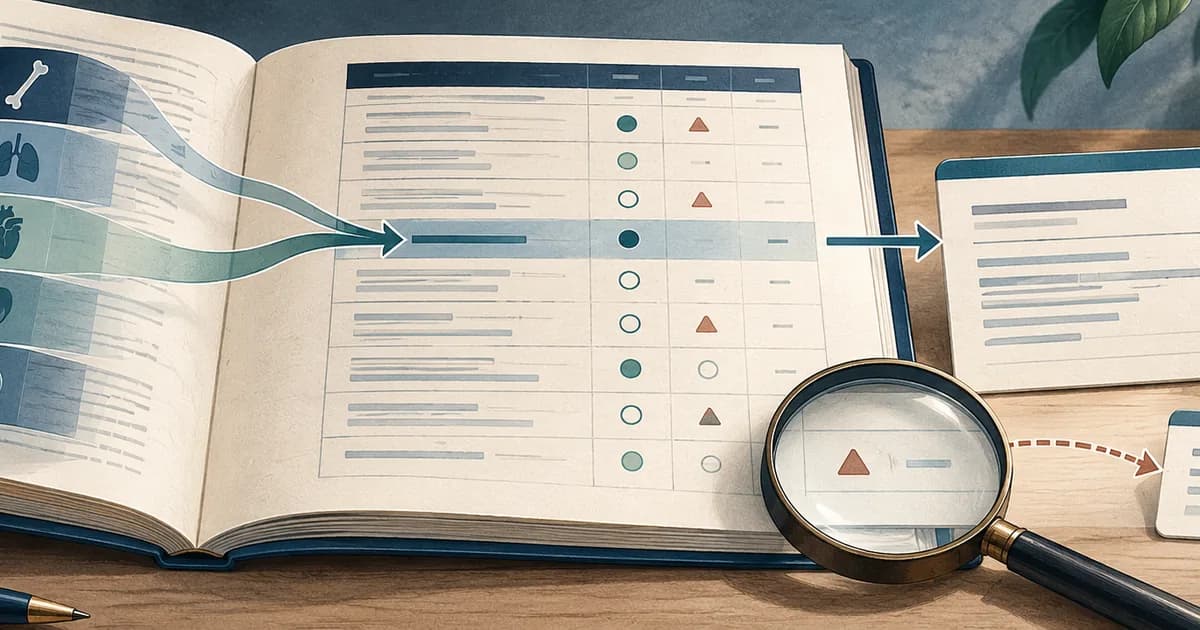
In the FY2027 Alphabetic Index, “see” sends you to the named main term to locate the correct code. “See also” offers another main term that may help; you need not follow it when the original term supplies the necessary code. Either path still ends with a complete Tabular List check.
Must I follow a “see also” reference?
Follow “see” to its named main term; follow “see also” when the original main term does not provide the necessary code and the second term may help. The FY2027 Official Guidelines, section I.A.16, distinguish two instructions. A “see” reference following a main term tells you to go to the named main term; that redirected term is necessary to locate the correct code. A “see also” reference identifies another main term that may contain useful entries. If the original main term already provides the necessary code, the guideline says following “see also” is not required.
This is a navigation rule for the U.S. FY2027 ICD-10-CM Alphabetic Index, not a rule to select a code from a phrase alone. CDC/NCHS lists FY2027 as applicable October 1, 2026 through September 30, 2027. For an actual record, the documented term, relevant subterms, Tabular List and setting-specific rules still need qualified review.
Source: CMS/NCHS: FY2027 Official Guidelines, sections I.A.16 and I.B.1
Two cross-references, two different next steps
The key is what each Index instruction asks you to do next, rather than treating both phrases as generic links. Keep the exact wording and destination visible during the lookup:
| Instruction after an Index main term | Next Index action | Can the original main term end the Index search? |
|---|---|---|
| See [another main term] | Go to that named main term to locate the correct code. | No. The redirected main term is necessary. |
| See also [another main term] | Consider that second main term for additional entries that may help. | Yes, when the original main term already provides the necessary code. |
“Optional” has a narrow meaning: the second Index main term need not be opened when the first is sufficient. It does not make the Tabular List optional. Section I.B.1 of the official guidelines requires a Tabular check after the Index lookup, including instructions in both places.
Source: CMS/NCHS: FY2027 Official Guidelines, sections I.A.16 and I.B.1
How to handle a “see” redirect without losing the path
Open the versioned FY2027 Alphabetic Index or the official CDC/NCHS FY2027 Index package. Under the documented main term, read its indented entries and the exact “see” destination. Then move to the named main term, rather than assuming the first term supplies a final code. Read the destination subterms and any further Index instructions before taking a candidate to the Tabular List.
For a reviewable lookup note, record: original main term → “see” destination → relevant destination subterm → candidate entry → Tabular verification. The arrow records a source route, not a claim that a particular diagnosis is established. Do not substitute a search snippet for the FY2027 source-file library or the official files. Our general Index-to-Tabular guide covers the full lookup sequence.
Source: CDC/NCHS: FY2027 official Alphabetic Index and Tabular List package
When the “see also” path is useful
If the original main term supplies a candidate that fits the documented wording, section I.A.16 does not require a detour through the “see also” main term. If the original entry does not provide the necessary code or a relevant detail remains unresolved, the second main term may expose entries worth checking. Compare the actual subterms and directions in both locations before moving on; do not assume the alternative is automatically more specific or correct.
The CDC/NCHS ICD-10-CM browser overview describes searching Index main terms and subterms, selecting a fiscal-year release, and switching between the Index and Tabular List. Those functions help compare two paths while retaining release context. The official FY2027 Index and Tabular package resolves the wording. A “see also” reference is a lookup aid; it does not say that two diagnoses or two codes should be reported.
Source: CDC/NCHS: ICD-10-CM browser and Index navigation overview
Finish every branch in the Tabular List
Once an Index route produces a candidate, section I.B.1 of the FY2027 guidelines directs you to verify that candidate in the Tabular List. Check the complete entry and applicable parent notes, inclusion or exclusion instructions, required characters and documented specificity. The Index does not always show the full code, and a dash is only one visible clue that more characters are needed. The Tabular check is required even if no dash appears.
“See” and “see also” move a reader between Index main terms; a Tabular note at a parent level can change how the final entry is interpreted. The FY2027 versioned reference lets you inspect that hierarchy. A navigation label does not, by itself, decide laterality, sequencing, reportability or clinical facts.
Source: CMS/NCHS: FY2027 Official Guidelines, sections I.A.16 and I.B.1
A compact, reusable review note
Diagram-ready takeaway: documented term → read the FY2027 Index instruction → see: follow the named main term; see also: compare the other main term if needed → verify the candidate in the full Tabular List. This flow has no invented diagnosis or patient. It shows where the optional branch ends and where the mandatory Tabular step begins.
When saving a lookup, keep the classification and release, original Index main term, cross-reference wording, any second main term consulted, final Tabular page and source link together. The ICD Code Hub apps for iPhone, Android and Mac offer convenient ways to revisit available code references across devices; use the official FY2027 Index and guidelines to resolve the instruction itself. The shared store links below lead to the current app listings.
Source: CDC/NCHS: FY2027 official Alphabetic Index and Tabular List package
Common questions
Is “see also” mandatory in the FY2027 Alphabetic Index?
No. FY2027 section I.A.16 says it need not be followed when the original main term provides the necessary code. The candidate still needs Tabular verification.
What should I do when the Index says “see”?
Go to the named main term. The official guideline says that destination is necessary to locate the correct code. Read its relevant subterms, then check the candidate in the Tabular List.
Does “see also” mean I should report a second code?
No. It identifies another Index main term that may contain helpful entries; it is not a multiple-coding instruction. Reporting decisions depend on documented conditions and the complete FY2027 classification and guidelines.
Can I use an Index candidate without opening the Tabular List?
No. FY2027 section I.B.1 requires the Index and Tabular List together. The Tabular entry establishes the complete code and applicable instructions, including required characters.
Sources & editorial notes
- CMS/NCHS: FY2027 Official Guidelines, sections I.A.16 and I.B.1
- CDC/NCHS: FY2027 official Alphabetic Index and Tabular List package
- CDC/NCHS: ICD-10-CM browser and Index navigation overview
- CDC/NCHS: FY2027 release files and effective dates
Scope: U.S. ICD-10-CM FY2027, October 1, 2026–September 30, 2027; Alphabetic Index navigation, not patient-specific code selection. Educational reference content, prepared with AI assistance; not independently reviewed by a credentialed clinical coding specialist. Verify official instructions and the applicable documentation before assigning codes. Our editorial approach.
Found an error? Send a correction.